





Eye For Film >> Movies >> Wuthering Heights: House Of The Damned (2026) Film Review


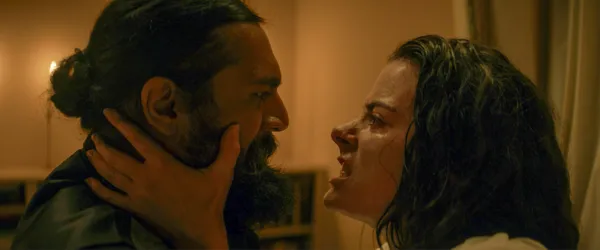

If you see one adaptation of Wuthering Heights made in 2026, do yourself a favour and make it Becca Hirani’s.
Based on the title, the trailer and even the opening scenes, you would be forgiven for thinking that this was something in the vein of Pride And Prejudice And Zombies, but this is no mere pastiche, and neither does it waste time licking the wallpaper. Yes, it’s over the top, but so was the love of which Emily Brontë wrote. There’s a lot of blood, and not just from childbirth, but this seems a fitting way to acknowledge the very real – and often mundane – brutality underlying the novel. All Hirani has done is to turn up the volume on what was already there.
She makes just one major adjustment. Here, though Cathy has still succumbed to the same fate, Heathcliff has refused to fade conveniently out of the narrative. Even in 1832, and certainly by 2026, minoritised people have been doing that for long enough. Here, it is a living man who meets Cathy’s ghost upon the moor, and rather than becoming like her, he strives to make her like him again.
Enter Mr. Lockwood (Ross Townsend-Green), the earnest gentleman to whom the original tale was told, riding across the moors on his white horse, Harper. With his dapper clothing and anxious manners, he is the perfect archetype of the polite bystander in a Jane Austen adaptation, a man who has spent his whole life surrounded by people who think and behave in the same way that he does. In Wuthering Heights, he is a fish out of water. His first encounter with Heathcliff (Sky Cheema) is a tangle of faux pas, and yet he experiences some kind of fascination that makes him feel compelled to go back a second time. The precise nature of this is unclear. Perhaps it really is all about his notion of proper behaviour. Perhaps there is a dark kind of magic at work, or perhaps it is something that he would find it even harder to countenance.
Next to Lockwood, Heathcliff looks as if he belongs to a different different kind of film, but perhaps he always belonged not just to a different culture but to a different genre, breaking into the book as he did when, so far as English Gothic readers of the time understood things, he had no right to be there. This is only the second time he has been played as a racially marginalised person (after Andrea Arnold’s 2011 version), and this is probably the closest he has looked to Brontë’s intention, but equally important is Cheema’s ability to fully inhabit the character, giving him both the physical power and the weight of charisma that the role demands. In flashback scenes and in Lockwood’s strange hallucinatory glimpses of the past, we see him as the unwanted, sometimes overtly abused outsider, but we also see him able to approach the world on his own terms. They say the best revenge is living well, but for those who have empathised with his plight over the decades, seeing him get a bit of actual revenge is pretty satisfying.
Again, this doesn’t so much stray from the plot as enlarge it and explore a particular set of interpretations. Opening on a dark and stormy night, Hirani makes it clear that she feels no obligation to tread lightly. This is the Gothic writ large. Like Mārama, it’s full of fury at racial injustice and the violence inherent in the class system. In giving Heathcliff space to be all of himself without the constraints of that system, it also creates space for Cathy. Elle O’Hara portrays her as someone simply too big for the world in which she is trapped. In the few moments that she she and Cheema share the screen, other characters become irrelevant, painfully aware of their own lack of purpose. Only Nelly (Nicola Wright) seems to retain a sense of herself – a narrator’s duty, even if she only occasionally gets to tell tales here. This is, in the end, a love story, and we have to believe in that to engage with it fully, to root for love when it and madness become one.
Townsend-Green deserves praise for navigating all this as a man who seems, at first, to be a figure of fun, prim and ineffectual, reminiscent in some ways of poor Sergeant Howie in The Wicker Man. Kept at the centre of things, though bitterly aware of his own lack of control, Lockwood finds his body wracked by fever as he is haunted and confounded by the many ghosts of the troubled house. At night, the windows rattle. Candles fail to behave as they usually do onscreen, and offer only small pools of light. Cathy, in a ragged grey dress, is never far away from him, and each glimpse brings him terror. It’s a hard-hearted viewer who won’t root for him too, or sympathise with his efforts to stand up for justice – even if some understand that the context of systemic oppression makes that far from simple.
The young heroes of An American Werewolf In London once assured us that Heathcliff didn’t howl, but here that doesn’t seem out of the question. Gently skirting the edge of comedy, of camp, Hirani’s film will delight and appal in equal measure, but all of it deservedly.
Reviewed on: 12 Oct 2026


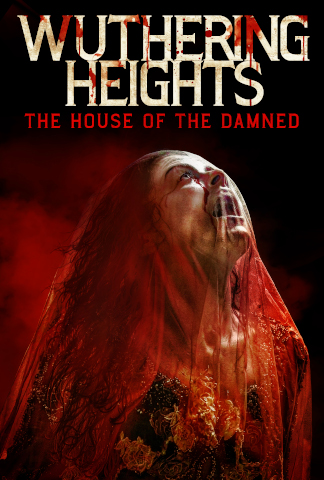
Director: Becca Hirani
Writer: Liana Failla, based on the book by Emily Brontë
Starring: Ross Townsend-Green, Sky Cheema, Elle O'Hara, Nicola Wright, Anna Coupé, Zach Devereux, Adria Jieanu, Gordon Joseph Millar
Year: 2026
Runtime: 100 minutes
Country: UK
Festivals:
Search database: